Monday, April 15, 2013

Bitch and Hate Poem


         The psychoanalytic approaches of the different parts of your mind are displayed in the poems Bitch and Hate Poem. These poems show that there are different pieces that make up your mind.  These pieces are the Id is the primal instinct, the Superego is the socially polite and conscious piece of your mind, and the Ego is the mediator between the two.  The poems Bitch and Hate Poem display these different parts and the battle between the Id, Superego, and Ego.
         In the poem Bitch by Carolyn Kizer, the Id, Ego, and Superego are clear in this poem because she is at war with herself, but expresses both sides during this poem. You can see how she has primal instincts when her guard is up and “As the bitch starts to bark hysterically” after she says something nice shows that the Id inside of her does not necessarily want to be friendly. The Id is her natural instincts of that when a dog does not understand why you are there, it starts to bark, and that is what she wanted to do. Her Ego is displayed when she says, “Where are your manners, I say, as I say” because consciously she knows that she has to be nice, and balance her feelings. “At a kind word from him, a look like the old days, / the bitch changes her tone; she begins to whimper. / She wants to snuggle up to him, to cringe” is the superego because she wants so badly to do this, but she can’t. The dog is a symbolic representation of the Id in this poem. She uses this dog because it is easier to accept a dog that runs off of their primal instinct, but not a human. Humans have the social responsibility to be respectable community members, while dogs can still be somewhat wild animals. 


         In Hate Poem by Julie Sheehan, almost the whole poem seems like an Id poem, because she doesn’t seem to be holding any of her feelings back. The first line of the poem reads, "I hate you truly. Truly I do."  This is not generally understood as a happy phrase, and sets the tone for the rest of the poem to be negative.  The negativity is balanced a little bit when the Ego piece of this poem comes out and she says “My pleasant ‘good morning’: Hate”. Even though she says, “hate” at the end of the line, she is still doing what is socially expected and being polite.  She is not acting like the dog in the poem Bitch, but she is trying to control herself.  The Id seems like it is the voice inside her head, and seems to be represented by the devil on her shoulder, while the Ego is the angel on the opposite side, forcing her to be nice. 


The message that Bitch sends is that the inner self battle can rage, but people still generally do what they are socially expected to do. Rather then saying she hates him, she said good morning. The message that Hate Poem sends is that there are different parts of yourself that need to be constantly put into check and that you need to be aware of. It shows there is an inner battle in everyone and that there are different parts of your personality that need to constantly be addressed.
         Both poems show the inner struggles people can have with the different parts of your mind. While we have continued to stress the importance of having good manners, and being polite, we as humans still have this basic desire to react on instinct alone.  Neither of these poems shows very productive relationships, and can expresses some of the inner struggles that happen when these relationships begin to fall apart. Without the other parts of the mind to keep us balanced, social society would fall apart.

Tuesday, April 9, 2013

rough draft psychoanalytic poems

1- topic sentence
1-3- example
4-5- analysis


The psychoanalytic approach of the different parts of your mind are displayed in the poems Bitch and Hate Poem. The Id is the primal instinct, the Superego is the socially polite and conscious piece of your mind, and the Ego is the mediator between the two.  The poems Bitch and Hate Poem display these different parts and the battle between the Id, Superego, and Ego.


In the poem Bitch by Carolyn Kizer, the Id, Ego, and Superego are clear in this poem because she is at war with herself, but expresses both sides during this poem. You can see how she has primal instincts when her guard is up and “As the bitch starts to bark hysterically” after she says something nice shows that the Id inside of her does not necessarily want to be friendly. The Id is her natural instincts of that when a dog does not understand why you are there, it starts to bark, and that is what she wanted to do. Her Ego is displayed when she says, “Where are your manners, I say, as I say” because consciously she knows that she has to be nice, and balance her feelings. “At a kind word from him, a look like the old days, / the bitch changes her tone; she begins to whimper. / She wants to snuggle up to him, to cringe” is the superego because she wants so badly to do this, but she can’t. The dog is a symbolic representation of the Id in this poem. She uses this dog because it is easier to accept a dog that runs off of their primal instinct, but not a human. Humans have the social responsibility to be respectable community members, while dogs can still be somewhat wild animals.


In Hate Poem by Julie Sheehan, almost the whole poem seems like an Id poem, because she doesn’t seem to be holding an
y of her feelings back. The first line of the poem reads "I hate you truly. Truly I do."  This is not generally understood as a happy phrase, and sets the tone for the rest of the poem to be negative.  The negativity is balanced a little bit when the Ego piece of this poem comes out and she says “My pleasant ‘good morning’: Hate”. Even though she says, “hate” at the end of the line, she is still doing what is socially expected and being polite.  She is not acting like the dog in the poem Bitch, but she is trying to control herself.  The Id seems like it is the voice inside her head, and seems to be represented by the devil on her shoulder, while the Ego is the angel on the opposite side, forcing her to be nice.


The message that Bitch sends is that the inner self battle can rage, but people still generally do what they are socially expected to do. Rather then saying she hates him, she said good morning. The message that Hate Poem sends is that there are different parts of yourself that need to be constantly put into check and that you need to be aware of. It shows there is an inner battle in everyone and that there are different parts of your personality that need to constantly be addressed. Both poems show the inner struggles people can have with the different parts of your mind. While we have continued to stress the importance of having good manners, and being polite, we as humans still have this basic desire to react on instinct alone.  Neither of these poems show very productive relationships, and can express some of the inner struggles that happen when these relationships begin to fall apart. Without the other parts of the mind to keep us balanced, social society would fall apart.
Tuesday, April 2, 2013

rough draft poems


Bitch

The Id, Ego, and Superego are clear in this poem because she is at war with herself, but expresses both sides during this poem.  You can see how she has primal instincts when her guard is up and “As the bitch starts to bark hysterically” after she says something nice shows that the Id inside of her does not necessarily want to be friendly.  The Id is her natural instincts of that when a dog does not understand why you are there, it starts to bark, and that is what she wanted to do.  Her Ego is displayed when she says, “Where are your manners, I say, as I say” because consciously she knows that she has to be nice, and balance her feelings.  “At a kind word from him, a look like the old days, / the bitch changes her tone; she begins to whimper. / She wants to snuggle up to him, to cringe” is the superego because she wants so badly to do this, but she can’t.

The dog is representing the Id of this poem.  She uses this dog because it is easier to accept a dog that runs off of this instinct, but not a human.  Humans have the social responsibility to be respectable community members, while dogs can still be somewhat wild animals.


The message that this poem sends is that there are different parts of yourself that need to be constantly put into check and that you need to be aware of.  It shows there is an inner battle in everyone and that there are different parts of your personality that need to constantly be addressed.


Hate Poem

Almost the whole poem seems like an Id poem, she doesn’t seem to be holding anything back.  The Ego piece of this poem is when she says “My pleasant ‘good morning’: Hate”.  Even though she says, “hate” at the end of the line, she is still doing what is socially expected and being polite.

The Id seems like it is the voice inside her head, and seems to be represented by the devil on her shoulder, while the Ego is the angel on the opposite side, forcing her to be nice. 

The message this poem sends is that the inner self battle can rage, but people still generally do what they are socially expected to do.  Rather then saying she hates him, she said good morning.


Both poems
Both poems show the inner struggles people can have with the different parts of your mind.  While we have continued to stress the importance of having good manners, and being polite, we as humans still have this basic desire to react on instinct alone. Without the other parts of the mind to keep us balanced, social society would fall apart.

Thursday, March 28, 2013

Psychoanalytic Poems


Bitch
by Carolyn Kizer
Now, when he and I meet, after all these years,
I say to the bitch inside me, don’t start growling.   (SUPEREGO)
He isn’t a trespasser anymore,
Just an old acquaintance tipping his hat.
My voice says, “Nice to see you,” (SUPEREGO)
As the bitch starts to bark hysterically. (ID)
He isn’t an enemy now,
Where are your manners, I say, as I say, (EGO)
“How are the children? They must be growing up.”   
At a kind word from him, a look like the old days,   (SUPEREGO)
The bitch changes her tone; she begins to whimper.   
She wants to snuggle up to him, to cringe.
Down, girl! Keep your distance
Or I’ll give you a taste of the choke-chain.
“Fine, I’m just fine,” I tell him.
She slobbers and grovels.
After all, I am her mistress. She is basically loyal.   
It’s just that she remembers how she came running   
Each evening, when she heard his step;
How she lay at his feet and looked up adoringly   
Though he was absorbed in his paper;
Or, bored with her devotion, ordered her to the kitchen   
Until he was ready to play.
But the small careless kindnesses
When he’d had a good day, or a couple of drinks,
Come back to her now, seem more important
Than the casual cruelties, the ultimate dismissal.
“It’s nice to know you are doing so well,” I say. (SUPEREGO)
He couldn’t have taken you with him;
You were too demonstrative, too clumsy,
Not like the well-groomed pets of his new friends.   
“Give my regards to your wife,” I say. You gag
As I drag you off by the scruff,
Saying, “Goodbye! Goodbye! Nice to have seen you again.”


The Id, Ego, and Superego are clear in this poem because she is at war with herself, but expresses both sides during this poem.  You can see how she has primal instincts when her guard is up and “As the bitch starts to bark hysterically” after she says something nice shows that the Id inside of her does not necessarily want to be friendly.  The Id is her natural instincts of that when a dog does not understand why you are there, it starts to bark, and that is what she wanted to do.  Her Ego is displayed when she says “Where are your manners, I say, as I say” because consciously she knows that she has to be nice, and balance her feelings.  “At a kind word from him, a look like the old days,/ The bitch changes her tone; she begins to whimper./ She wants to snuggle up to him, to cringe” is the superego because she wants so badly to do this, but she can’t.


The message that this poem sends is that there are different parts of yourself that need to be constantly put into check and that you need to be aware of.  It shows there is an inner battle in everyone and that there are different parts of your personality that need to constantly be addressed.


From a Correct Address in a Suburb of a Major City
By Helen Sorrels (1908)

She wears her middle age like a cowled  (SUPEREGO)
Gown, sleeved in it, folded high
At the breast

Charming, proper at cocktails  (EGO)
But the inner one raging  (ID/ EGO)
And how to hide her

How to keep her leashed, contain (EGO)
The heat of her, the soaring cry
Never yet loosed,

Demanding a chance before the years devour her,
Before the marrow of her fine long legs
Congeals and she

Settles forever for this street, this house,
Her face set to the world
Sweet, sweet

Above the shocked, astonished
hunger

Hate Poem

By Julie Sheehan

I hate you truly. Truly I do.

Everything about me hates everything about you.

The flick of my wrist hates you.

The way I hold my pencil hates you.

The sound made by my tiniest bones were they trapped in the
  
jaws of a moray eel hates you.

Each corpuscle singing in its capillary hates you.

Look out! Fore! I hate you.

The blue-green speck of sock lint I’m trying to dig from
  
  under my third toenail, left foot, hates you.

The history of this keychain hates you.

My sigh in the background as you pick out the cashews hates you.

The goldfish of my genius hates you.

My aorta hates you. Also, my ancestors.

A closed window is both a closed window and an obvious

symbol of how I hate you.

My voice curt as a hairshirt: Hate.

My hesitation when you invite me for a drive: Hate.

My pleasant “good morning”: Hate.
  (EGO)
You know how when I’m sleepy I nuzzle my head under your
 arm? Hate.

The whites of my target-eyes articulate hate.
My wit practices it.

My breasts relaxing in their holster from morning to night hate you.

Layers of hate, a parfait.

Hours after our latest row, brandishing the sharp glee of hate,

I dissect you cell by cell,
so that I might hate each one
   
individually and at leisure.

My lungs, duplicitous twins, expand with the utter validity of
 my hate,
which can never have enough of you,

Breathlessly, like two idealists in a broken submarine.

Almost the whole poem seems like an Id poem, she doesn’t seem to be holding anything back.

Wednesday, March 20, 2013

The Hero Journey Tale


The Hero Journey Tale and The Odyssey
          The Odyssey by Homer is a classic hero journey tale. It is laid out in a particular way that makes the theme easily identifiable. It also has different character archetypes and all of these pieces have transferred into our current popular culture. This story was important when it was written, but is still important today even though thousands of years have passed. There are many ways that this story is present in our popular culture and shapes the themes of today.  Why is the hero journey tale presented in The Odyssey still a major storytelling method and why it will continue to be?
            The hero journey tale is when the main character or hero goes through certain stages throughout the story. These stages are the call to action where the hero is in some way summoned to do this, refusal of the call where the hero goes through a period of self doubt and wants to give up, getting advice from someone else which can sometimes be a supernatural being, and success in his quest. Some things that happen in our everyday lives are when the alarm clock goes off in the morning, that's just like our call to action. These stages and plot make it easy to identify its main theme. Each stage plays an important part in helping the character develop and eventually succeed. They are usually trying to improve their reputation or help their community. In The Odyssey, the main character is going on a sea adventure to find his father and bring him home to rule the kingdom.  Family legacy was very important to them and he did not want his father's name disrespected.
            The different character archetypes also play a major role in helping the main character to succeed.  These archetypes also come into play at certain stages in the plot, and they all affect one another.  These characters resemble people that we can encounter in our everyday lives.  Some are good and helpful, and some try to steer you away from the right path to follow.  We want to be able to identify ourselves with the hero, and pick out the other people in our lives that resemble the different archetypes.  Some archetypes are Odysseus who is the trickster, Telemakhos who is the hero, Calypso who is the temptress, and Athena who is the supernatural help.  Telemakhos finally gets his call to action from Athena when she says, ”…here’s a course for you, if you agree: get a sound craft afloat with twenty oars and go abroad for news of your lost father –- (429).  This is when he realizes that he has to take matters into his own hands in order to rid his mother of her suitors and bring his father home.  Athena helps him to see his true potential. These archetypes are very important pieces in the different stages that the hero must go through to reach the end of his journey.  Without these characters, the story would not flow the same.
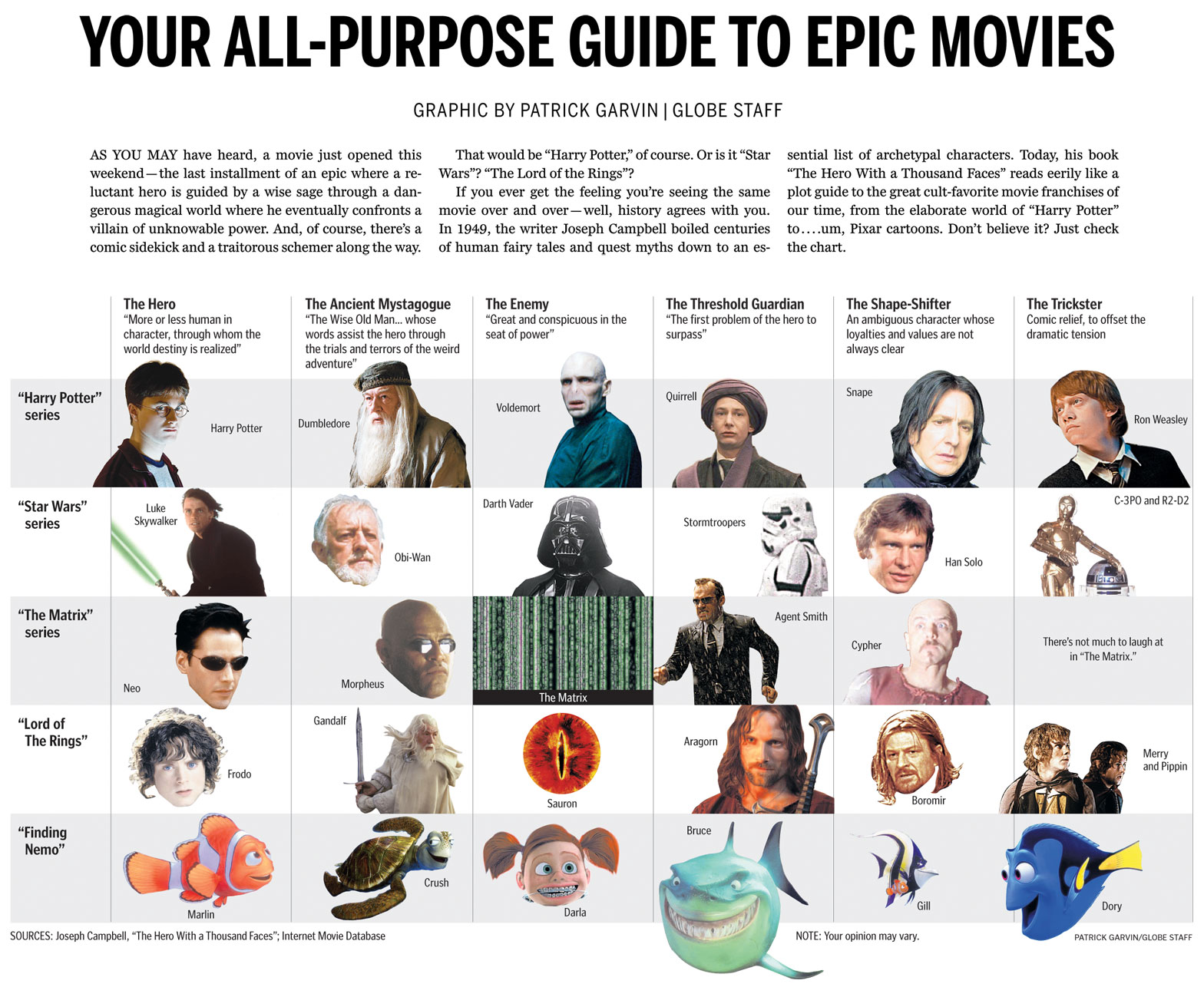
            The theme of a hero's journey tale is also present in some of our current popular culture. Even though The Odyssey was written thousands of years ago, the theme and the character archetypes still play a major role in today's society. The Disney movie Finding Nemo is a perfect example. In this movie, the hero, Marlin, is on a quest to find his son and bring him home. Along the way he meets some characters that try to help him along the way, and push him a few steps backwards. He is faced with different challenges and goes through the same stages that Telemakhos goes through in The Odyssey. All of these pieces make up this hero's journey to find his son.
            This theme is still used today not just because it makes for a good story, but because they are stories we can relate to. Everyone likes to see the good guy win especially if they do not look like they are heading in that direction. Even though The Odyssey was written thousands of years ago, the types of struggles that the hero goes through make him relatable.  We want to be able to identify our lives with the way that the hero handles his hardships and is able to overcome them. The hero often stands out because we do not immediately like them, or as a type of role model because of his distinct personality traits. People like to see the transformation from bad to good and the changes that they make. Sometimes their negative traits can push them forward because they want to move past that and prove themselves worthy. Even though the heroes may present themselves in an ordinary way, they are not.  They are a form of who we want to be. They rise above their own issues and self-doubt and that is one of the reasons they are so desirable.  Everyone wants to overcome all the things that life throws at them. Sometimes some of the obstacles the hero must overcome are even more relatable to a particular point in a person’s life. For example, if the hero has to get physically fit for a quest, which could be like the marathon, you are trying to build up to. If they can do it when it doesn't look like they can, then you can do it too.  People want to relate to other people and they want to succeed. We admire their ability to overcome all of this. We also want to be reassured in our own lives that everything we go through will be worth it in the end and these stories prove that to be true. The characters also make for an interesting story. We all like the twists and turns and to think of the different ways this story could go. For example, if the hero meets this temptress, could he be swayed to go with her? Or maybe he could stick to what he is supposed to do? Everyone always has different ideas and endings as the stories progress. Sometimes the story that you are watching in the movie theaters is a hero journey tale, and you don't even know it. 

Tuesday, March 12, 2013

Midterm Blog Rough Draft


The Odyssey
          The Odyssey by Homer is a classic hero journey tale. It is laid out in a particular way that makes the theme easily identifiable. It also has different character archetypes and all of these pieces have transferred into our current popular culture. This story was important when it was written, but is still important today even though thousands of years have passed. There are many ways that this story is present in our popular culture and shapes the themes of today.  Why is the hero journey tale presented in The Odyssey still a major storytelling method and why it will continue to be?
            The hero journey tale is when the main character or hero goes through certain stages throughout the story. These stages are the call to action, refusal of the call, getting advice, and success.  These stages and plot make it easy to identify its main theme. Each stage plays an important part in helping the character develop and eventually succeed. They are usually trying to improve their reputation or help their community. In The Odyssey, the main character is going on a sea adventure to find his father and bring him home to rule the kingdom.  Family legacy was very important to them and he did not want his father's name disrespected.
            The different character archetypes also play a major role in helping the main character to succeed.  These archetypes also come into play at certain stages in the plot, and they all affect one another.  These characters resemble people that we can encounter in our everyday lives.  Some are good and helpful, and some try to steer you away from the right path to follow.  We want to be able to identify ourselves with the hero, and pick out the other people in our lives that resemble the different archetypes.  Some archetypes are Odysseus who is the trickster, Telemakhos who is the hero, Calypso who is the temptress, and Athena who is the supernatural help.  Telemakhos finally gets his call to action from Athena when she says, ”…here’s a course for you, if you agree: get a sound craft afloat with twenty oars and go abroad for news of your lost father –- (429).  This is when he realizes that he has to take matters into his own hands in order to rid his mother of her suitors and bring his father home.  Athena helps him to see his true potential. These archetypes are very important pieces in the different stages that the hero must go through to reach the end of his journey.  Without these characters, the story would not flow the same.
            This theme of a hero's journey is still present in some of our current popular culture. An example of this is the Disney movie The Lion King. In this movie, the main character, Simba, has to return home to save his kingdom. He is faced with all kinds of challenges and then receives a message from his father in the sky. Without experiencing these different stages and having the different interactions with the characters, Simba's decision or success could have drastically changed.
            This theme is still used today not just because it makes for a good story, but because they are stories we can relate to. Everyone likes to see the good guy win especially if they do not look like they are heading in that direction. Even though The Odyssey was written thousands of years ago, the types of struggles that the hero goes through make him relatable.  We want to be able to identify our lives with the way that the hero handles his hardships. The hero often stands out as a type of role model because of his distinct personality traits and even though they present themselves in an ordinary way, they are not. They rise above their own issues and self-doubt and that is one of the reasons they are so desirable.  Everyone wants to overcome all the things that life throws at them. People want to relate to that. We admire their ability to overcome all of this. We also want to be reassured in our own lives that everything we go through will be worth it in the end and these stories prove that to be true. 

Thursday, February 21, 2013

Toys from my childhood

When I was a kid, legos were my favorite toy.  But I also played with cars, dinosaurs, plastic animals, and dolls.  I had a mix of everything growing up.  I used to build cars and houses out of legos, and sometimes put my toy animals in them.  My best friend is a boy, and we grew up together and are still very close so that could have had an impact on me as well.  I think that having a variety of not very "girly" toys somewhat made me into a tomboy growing up.  I also think that this is still somewhat true today.  I am drawn to things that are not typically advertised for women, but also things that are.  My parents allowed me to have a balanced mix of the influences I grew up with and I think that had a greater impact on me.

Thursday, February 14, 2013

Questions for Exodus and Genesis

1.     What are the roles of men and women in Exodus, Genesis, Gilgamesh, and the Odyssey?
In Exodus the role of men in the story of Moses and the flood is that this man has been chosen by God to save all the people and animals and help repopulate the world.  since God chose a man to take on this responsibility it leaves me to wonder if he did that because he thought a woman could not do it, or if he thought a man would just do it better.  In Genesis, the role of women in the creation story is that women are the source of all evil and sin.  Eve is the one that disobeys God and eats the forbidden fruit and then turns Adam over to the “evil” side.  Eve is portrayed very negatively and the story makes her seem like she is easily persuaded to do things and that she is a bad example for men to follow.


2.     Identify the archetypes: the mother figure, the “Eve” character, and the wholesome young woman character.
The “Eve” character is very easily identified in Genesis because that is where the character started.  She is the start of the fall of human kind and the one that tempts Adam into sin.  In Gilgamesh this temptress also gets him to leave his forest living with the animals and turn into more of a “real man”. The mother figure in the Odyssey is the goddess who comes to lead the main character to find his father and help him on his journey. The young women character in the Odyssey is the character's mother. I say this because she is leading all of these young men on and can't really make up her mind or finish what she starts.

3.     What are the roles of the male characters? How does it differ from the female roles?
The roles of the male characters in Exodus,Gilgamesh, and the Odyssey is the hero.  In all of these stories, the man is trying to prove himself heroic or rescue someone.  In Exodus, Moses is trying to save the people and animals from the flood representing the end of the world.  In Gilgamesh, he is going on an adventure to make a better name for himself and defeat the forest protector.  In the Odyssey, he is trying to save his father.  The role of the male character in Genesis is different than these other stories and he seems more like a follower who gives into the temptations of the woman.

4.     What do these character’s roles say about the way women are viewed in this time period? Has it changed now in the way women are viewed?
These character roles make women out to be the “bad guys” and the weaker of the sexes.  These archetypes seem to put women into small and negative boxes or boxes that need defending.  I do not think that the real idea of how men and women are viewed has completely changed because these stories are so imbedded into us.  There is more equality and opportunities available, but i think society still views them in a lesser way.

5. Think of one piece of popular literature, one movie, and one television show, and give an example of archetypes presented in the media and dissect the message it sends about roles.

Wednesday, February 6, 2013

Rebirth and new beginnings

The stories that we read from Genesis are pretty classic stories, especially of the flood.  God offers help and guidance and instruction for Noah who is the hero. Because his faith is so strong, he is chosen to build the arc and get the animals and survive the flood and help repopulate the earth. The flood acts as the apocalypse, and wipes out all the evil on earth.  The reason we are able to connect to this story is because it is like having a clean slate and starting over or moving to a new place and that is exciting and has appeal when things in life are not going the way that we want them to.

Wednesday, January 16, 2013

2 Poems

2 Poems


Prayer for a Snowy Day

This poem used one simile towards the end of the poem, and some wording that reminds me of a metaphor.  There is no real rhyming or pattern to this.  This poem is written in a very interesting format and it caught my attention.  It seems to be about a man being open to what is happening around him.  The first part of the poem has a lighter feeling then the second part.


Burlap Sack
by Jane Hirshfield

This poem does not use any simile or metaphor.  There is no rhyme and is structured pretty normally.  it seems to be about the hardships of life.  It really makes you think about what you have to deal with in life and how it weighs you down.

Thursday, January 10, 2013

My name is Lauren Dallas.  I am a junior at NDNU and I am a liberal studies major.  I want to teach elementary special needs children with autism and other mental handicaps.  I hope to make a difference in the lives of these children and their families and the way that society views this group of people.  When I am not at school, I work at a pet store in Campbell called Pets and More.  This pet store specializes in reptiles, and reptiles are one of my hobbies.  I have a few pets at home that I also try to devote my attention to.  I enjoy reading in some of my free time, and some of my favorite authors are Jodi Picoult and Ellen Hopkins.  I also enjoy reading and writing poetry on occasion.